Blog
Why Your Website Matters More Than Social Media in 2026
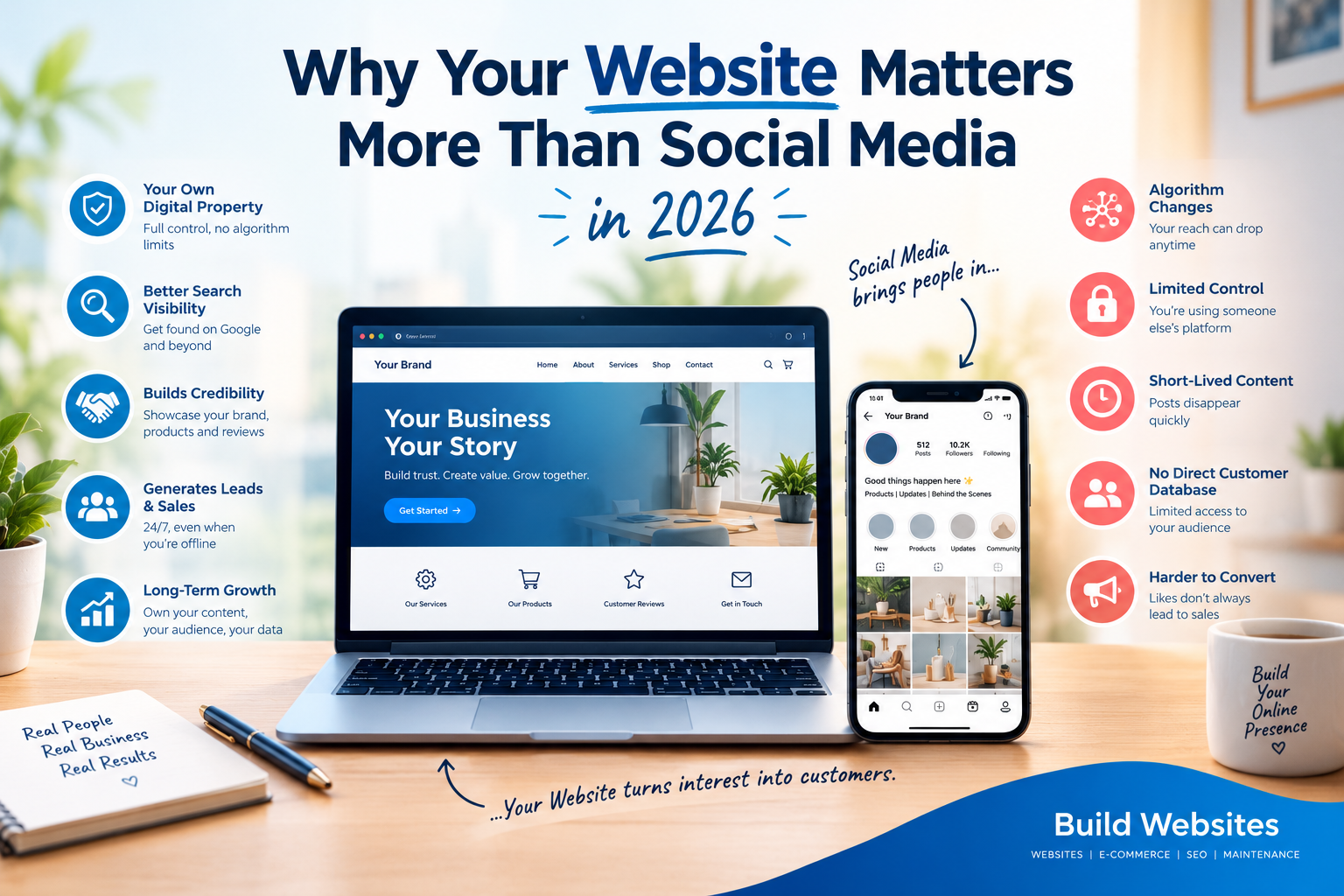
Social media has become an essential part of modern business marketing. Platforms like Instagram, Facebook, LinkedIn, and YouTube help businesses connect with audiences, promote products, and build brand awareness. However, relying entirely on social media to grow a business can be risky.
In 2026, having a professional website is more important than ever. Social media can help people discover your business, but your website gives them a reliable place to learn about your services, explore your offerings, and take action.
A website is not simply an online presence. It is a digital asset that your business owns and controls.
Let’s understand why a website can be more valuable to your business in the long run than relying only on social media.
1. Your Website Is Your Digital Property
When you build a business presence on social media, you are using a platform owned and controlled by another company.
Social media platforms can change their algorithms, policies, features, and reach at any time. Your posts may receive fewer views even if you have a large following.
A website gives you greater control over your online presence.
You decide:
- How your business is presented.
- What information visitors can access.
- How your products and services are organised.
- Which features and functionalities you offer.
- How customers contact or purchase from you.
Unlike a social media profile, your website is a digital property that you can develop according to your business goals.
2. You Are Not Dependent on Social Media Algorithms
One of the biggest challenges of social media marketing is unpredictable reach.
You may spend hours creating content, but only a small percentage of your followers might see it. Changes in platform algorithms can affect how frequently your content appears in users’ feeds.
A website gives your business another way to attract visitors.
With search engine optimisation (SEO), useful blog content, and properly structured website pages, potential customers can discover your business through Google and other search engines.
Your website can continue attracting visitors even when you are not publishing daily social media posts.
3. A Website Builds Greater Business Credibility
Customers often research a business before making a purchase or contacting a service provider.
A professional website helps establish trust by providing essential business information in one place.
You can showcase:
- Your company’s background and experience.
- Products and services.
- Portfolio and previous projects.
- Customer testimonials and reviews.
- Contact details and business location.
- Frequently asked questions.
While a social media profile is useful for engagement, a well-designed website offers a more organised and comprehensive presentation of your business.
For many customers, having an official website makes it easier to verify that a business is established and accessible.
4. Your Website Helps You Get Found on Search Engines
Social media content is generally discovered through platform feeds, recommendations, hashtags, and searches within individual platforms.
A website gives your business the opportunity to appear in search engine results when people look for relevant products, services, or information.
For example, someone searching for:
- Website development company in Kolkata
- Best jewellery store online
- Digital marketing services for small businesses
- Affordable website design for startups
may discover relevant business websites through Google.
By publishing helpful content, targeting relevant keywords, improving technical SEO, and maintaining useful website pages, you can build long-term organic visibility.
Your website can also provide structured information that helps search engines and AI-powered search experiences understand your business.
5. You Have More Control Over Customer Experience
Social media platforms provide a standardised layout. Although you can customise your profile to some extent, you cannot completely control the user experience.
A website allows you to design the customer journey around your business objectives.
You can include:
- Dedicated service and product pages.
- Custom enquiry forms.
- Online booking systems.
- Product filters and search.
- Shopping carts and checkout facilities.
- WhatsApp integration.
- Live chat and customer support.
- Downloadable catalogues and resources.
For example, an e-commerce business can create a complete shopping experience with product categories, detailed descriptions, payment options, order tracking, and customer accounts.
This level of flexibility makes a website a powerful business tool rather than just a promotional platform.
6. Your Website Can Generate Leads and Sales 24/7
Your social media accounts can attract attention, but customers may still need to send messages, wait for replies, or request additional information before taking action.
A website can automate several parts of this process.
A business website can:
- Collect enquiries through contact forms.
- Display services and pricing information.
- Accept online orders.
- Process payments.
- Schedule appointments.
- Provide answers through FAQs.
- Capture potential customer information with permission.
This means customers can explore your business and take the next step even outside your regular working hours.
A well-structured website reduces unnecessary communication and makes it easier for interested visitors to become customers.
7. Your Website Supports Long-Term Content Marketing
Social media posts often have a short period of visibility. A post may receive engagement for a few days and then disappear from the audience’s attention.
Website content can have a much longer lifespan.
Blogs, guides, tutorials, case studies, and service pages can continue attracting relevant visitors through search engines.
For example, a web development company publishing articles about website design, SEO, security, and e-commerce can attract business owners who are actively looking for solutions.
You can also share these articles across social media platforms, giving each piece of content multiple opportunities to reach potential customers.
8. You Can Build Your Own Customer Database
Social media followers are not the same as customers whose contact information you have permission to use.
Your followers remain part of a platform’s ecosystem, and you may not always have direct access to them.
A website can help you build direct customer relationships through:
- Newsletter subscriptions.
- Enquiry forms.
- Customer registration.
- Account creation.
- Order information.
- Permission-based email marketing.
With appropriate privacy policies and consent, you can use these channels to communicate with customers, share updates, and build long-term relationships.
This reduces your dependence on any single social media platform.
9. A Website Strengthens Your Social Media Marketing
Choosing between a website and social media is not necessary. Both can work together.
Social media is excellent for creating awareness, sharing updates, engaging with followers, and building a community.
Your website can turn that interest into meaningful business actions.
Consider this simple customer journey:
- A potential customer discovers your Instagram post.
- They visit your website to explore your products or services.
- They read customer reviews and learn more about your business.
- They submit an enquiry or place an order.
In this approach, social media attracts attention while your website provides the information and functionality needed to convert that attention into action.
10. Your Website Prepares Your Business for the Future of AI Search
Online search is evolving. People are increasingly using AI-powered tools and conversational search experiences to discover businesses, compare services, and find answers.
A properly structured website can help these systems understand your business more clearly.
Important elements include:
- Clear and informative website content.
- Proper heading structure.
- Organisation and Local Business schema where relevant.
- Frequently asked questions.
- XML sitemap.
- Appropriate robots.txt configuration.
- Consistent business information.
- Relevant internal links and well-organised pages.
No website can guarantee that an AI platform will recommend or mention a business. However, maintaining accurate, accessible, and well-structured information gives search systems a better foundation for understanding your business.
Website vs Social Media: Which Is Better for Your Business?
Both serve different purposes. Here is a simple comparison:
| Feature | Business Website | Social Media |
|---|---|---|
| Ownership | Greater control | Platform-controlled |
| Design flexibility | Highly customisable | Limited |
| Search visibility | SEO and search discovery | Platform-based discovery |
| Customer experience | Customised | Standardised |
| Lead generation | Forms, bookings, enquiries | Messages and platform tools |
| E-commerce | Complete online store | Platform-dependent features |
| Content lifespan | Can remain discoverable long-term | Often short-lived |
| Customer database | Can build with consent | Limited platform access |
| Brand presentation | Fully customisable | Profile-based |
Should You Choose a Website or Social Media?
The best approach is to use both strategically.
If you are a new business, social media can help you start building an audience without a large initial investment. However, you should consider developing a professional website as your business grows.
If you already have an established business, relying only on social media may limit your opportunities to attract search traffic, generate enquiries, and build a more independent online presence.
Your website should act as the central hub of your digital presence, while social media platforms should support your marketing and customer engagement activities.
Final Thoughts
In 2026, social media is an important marketing channel, but it should not be the only foundation of your business’s online presence.
A website gives you greater control, improves your opportunities for search visibility, builds credibility, supports customer engagement, and creates a platform that can grow alongside your business.
Think of social media as a way to bring people to your business and your website as the place where they can properly understand, trust, and connect with your brand.
Don’t just build followers. Build your digital presence.
At Build Websites, we help businesses establish a professional online presence through responsive website design, e-commerce development, SEO, website maintenance, and AI Search Optimization.
Your business deserves more than just a social media profile. It deserves a website that works for it.
Share this post

Contacts
-
D-45/A/4, Shibalaya, 2nd Floor, Module - S1, Rabindrapally, Kolkata -700086, West Bengal, India
-
We Accept:
